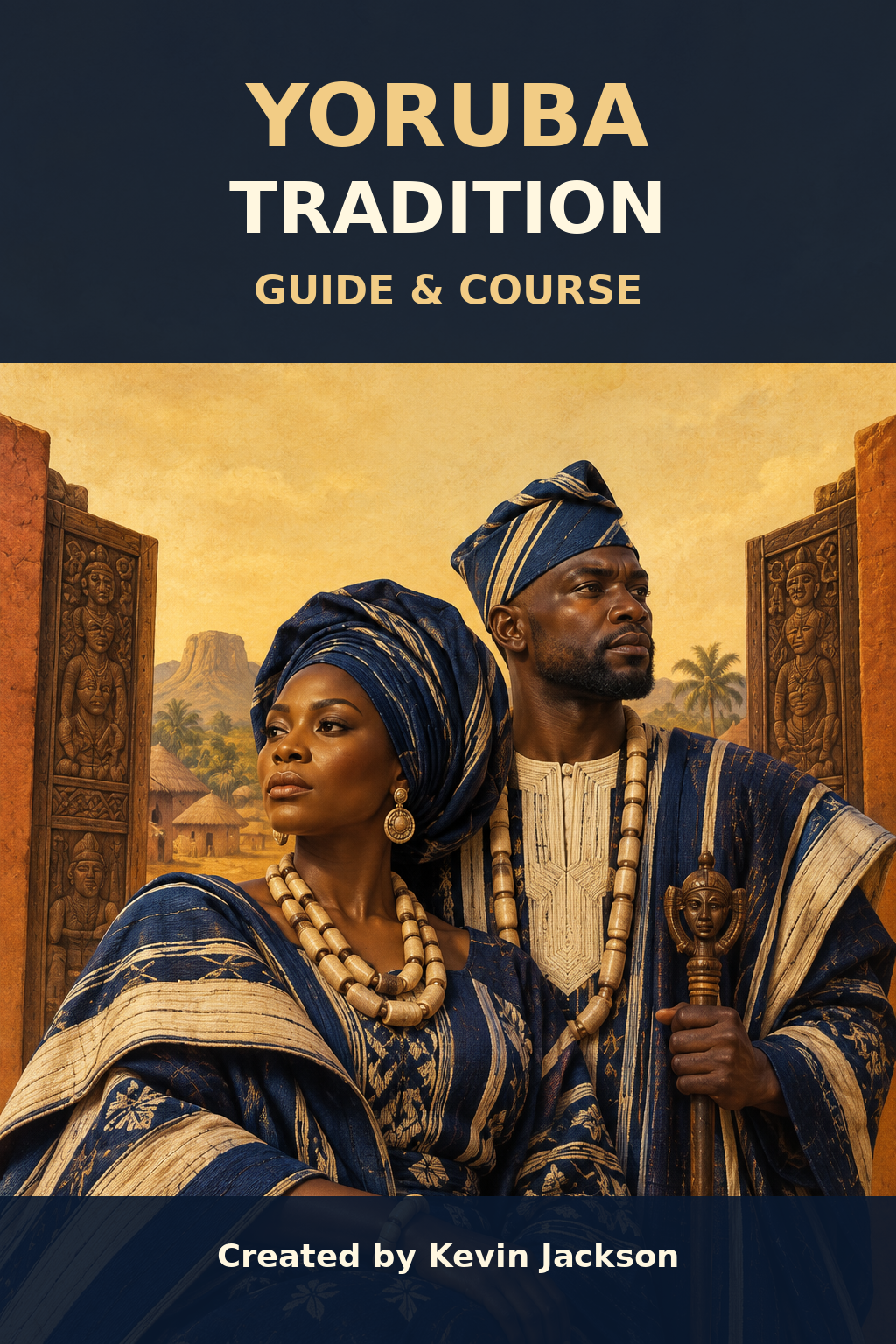
Yoruba Tradition
Guide & self-contained course · Created by Kevin Jackson
Guide & self-contained course · Created by Kevin Jackson
Explore Yoruba people, language, religious ideas, art, and Atlantic legacies. 19 modules, activities, a 20-question assessment, and a printable completion certificate are included.
Completion: mark all 19 activities, confirm your capstone, and score at least 80% on the quiz. You may retry. Your progress stays in this browser and is not sent to BEN.
MODULE 1 OF 19 · ABOUT 25 MINUTES
Yoruba communities are rooted especially in southwestern Nigeria and neighboring Benin and Togo. Yoruba is also a language with regional varieties; tone changes meaning. The word Yoruba names people, language, and a broad cultural inheritance, not one uniform religious identity.
Yoruba people today practice Christianity, Islam, Indigenous traditions, combinations of these, or no religion. Families and local communities differ. Study the tradition without treating every Yoruba person as a representative of one belief system.
Ilé-Ifẹ̀ holds great importance in Yoruba origin narratives and art history. Ọ̀yọ́ was an influential kingdom, while towns such as Òṣogbo, Abẹ́òkúta, and Ìjẹ̀bú have distinct histories. Oral accounts and scholarship should be read together.
On a map, locate southwestern Nigeria, Benin, Ilé-Ifẹ̀, and Ọ̀yọ́. Write two sentences distinguishing Yoruba identity from Yoruba traditional religion.
MODULE 2 OF 19 · ABOUT 25 MINUTES
Yoruba uses tonal marks and underdots in standard spelling. You will also see simplified spellings in English publications. Do not assume an English approximation captures a term completely.
Proverbs, praise poetry (oríkì), stories, song, and performance carry histories and values. A proverb needs context and a knowledgeable speaker; literal translation can miss its social meaning.
Elders, artists, scholars, and practitioners are living sources. Ask permission before recording, publishing, or sharing a person’s teaching or an image of a ceremony.
Choose one public museum object record. Note the artist or community attribution, place, date, and what the record does not tell you.
MODULE 3 OF 19 · ABOUT 35 MINUTES
In many accounts of Yoruba traditional religion, Olódùmarè is understood as the supreme source of existence, and òrìṣà are powers or divine beings with distinct relationships and stories. Descriptions vary by lineage and region.
Àṣẹ is often discussed as a power or capacity to bring things into effect; ìwà concerns character and conduct. Neither is a simple synonym for “magic.” Good character, responsibility, and relationships recur in accounts of Yoruba thought.
Orí literally means head and, in many discussions, also signifies the inner head or personal destiny. Interpretations are complex and differ. Avoid presenting destiny as an excuse to ignore personal responsibility.
Remembering ancestors can express lineage, gratitude, and communal continuity. Practices of remembrance vary, including among families who do not participate in traditional religion.
Make a two-column glossary: each term and one sentence about what is known, plus one question you would ask a knowledgeable teacher.
MODULE 4 OF 19 · ABOUT 40 MINUTES
Èṣù is associated in many accounts with communication and the crossroads; Ògún with iron and skilled work; Ọ̀ṣun with a river and healing or fertility themes; Ṣàngó with thunder and royal power; Ọbàtálá with creation and ethical ideals; Yemoja with maternal and water themes. Associations and names shift across communities and the diaspora.
An òrìṣà is not a personality type, a universal color code, or an interchangeable character in every Atlantic tradition. Accounts vary by town, lineage, and religious house.
Beads, tools, songs, and visual forms can have meanings governed by specific communities. This course names public concepts without assigning anyone an òrìṣà or teaching offerings or consecration.
Choose two òrìṣà. Compare how a museum or scholarly source describes them, and record one difference in context or spelling.
MODULE 5 OF 19 · ABOUT 30 MINUTES
Ifá is a Yoruba divination and knowledge tradition associated with Ọ̀rúnmìlà and a vast corpus of oral verses. UNESCO recognizes its importance as intangible cultural heritage.
Specialists learn through sustained study and relationship with teachers. An introductory course can explain the public history of Ifá; it cannot qualify a learner to perform divination, interpret odù, or prescribe rituals.
When comparing online claims, prefer identifiable practitioners, museums, and scholarly work. Note who is speaking and what community or lineage they represent.
Read UNESCO’s public overview. Identify two reasons oral transmission matters and one question the overview leaves open.
MODULE 6 OF 19 · ABOUT 30 MINUTES
Carved vessels, sculpture, textiles, beadwork, and architecture connect artistic skill with patronage, history, and social meaning. An object in a museum was made for a particular context, not as generic decoration.
Gèlèdé performance honors the significance of women, mothers, and elders in communities where it is practiced. Egúngún traditions connect masquerade and ancestral remembrance. These are distinct traditions and vary by location.
Talking drums, bàtá ensembles, dance, and praise poetry participate in public and religious settings. A drum rhythm is more than background music; its significance depends on performer and occasion.
Compare the descriptions of an Ifá vessel and a Gèlèdé performance. Explain why object and performance need different kinds of documentation.
MODULE 7 OF 19 · ABOUT 30 MINUTES
The Atlantic slave trade violently displaced West Africans. Descendants sustained and transformed languages, artistic forms, and religious knowledge in the Americas.
Lucumí or Regla de Ocha in Cuba and Candomblé in Brazil have Yoruba connections and their own histories, authorities, languages, and practices. They should not be presented as identical copies of one Nigerian tradition.
Yoruba culture and spirituality continue to change through migration, artists, scholarship, family life, and contemporary practitioners. Avoid a frozen, ancient-only portrayal.
Write 150 words about continuity and change using one African and one diaspora example, with citations.
MODULE 8 OF 19 · ABOUT 55 MINUTES
Ilé-Ifẹ̀ is prominent in narratives of the formation of the world and the emergence of Yoruba political and artistic traditions. Stories associated with figures such as Odùduwà have more than one version and can speak about sacred beginnings, descent, kingship, and belonging. A sacred account and an archaeological claim answer different questions. Learners should name the community and source of each version rather than choose one retelling as the universal Yoruba story.
The historic Ọ̀yọ́ empire, Ifẹ̀, Ẹ̀gbá, Ìjẹ̀bú, Èkìtì, and other regions developed distinct institutions and relationships. Trading networks, royal courts, craft centers, and religious specialists changed over time. Even when an òrìṣà is widely known, a town may have its own origin account, praise names, shrines, festivals, and custodians. The phrase “the Yoruba religion” is useful for introduction but conceals this local detail.
Missionaries and colonial administrators recorded some traditions through their own categories, often calling practices “superstition” or reducing complex authorities to a single hierarchy. Museum labels and early publications can preserve valuable evidence and still carry these distortions. Contemporary Yoruba scholarship, oral testimony, and careful object histories help learners recognize both what an archive records and whose voices are missing.
A river, grove, market, crossroads, or palace can be a social, ecological, and religious place at once. Respect for a named site includes attention to local people, custodianship, environmental change, and visitor rules. A photograph alone does not convey who maintains the place or how access is governed.
Make a two-column timeline separating a sacred origin account from dated historical evidence. Identify the speaker or author for each entry.
MODULE 9 OF 19 · ABOUT 60 MINUTES
Accounts often distinguish aiyé, the visible world of human life, from ọ̀run, an unseen realm associated with spiritual beings and ancestors. The relationship is not simply a Western heaven-versus-earth diagram. Terms have different emphases across texts, communities, and languages of translation. Study them as part of a lived worldview rather than as a fixed chart.
Orí means the physical head and, in religious and philosophical discussion, the inner head or personal destiny. Stories of choosing destiny before birth appear in various accounts, but people interpret the relationship between destiny, character, effort, and circumstance differently. The idea is most useful here as a question about responsibility: how does one act well within the life one has? This course does not diagnose anyone’s destiny.
Ìwà refers to character; ìwà pẹ̀lẹ́ is often discussed as gentle or good character. Patience, truthfulness, generosity, humility, and care for others appear in ethical teachings, although no short list captures every context. Compare the way a proverb or Ifá narrative makes an ethical point with a slogan that extracts only a single sentence.
Àṣẹ is discussed as efficacy or power by which speech and action bring things about. It relates to persons, divine powers, ancestors, and the wider world in many accounts. Treating it as an automatic spell or a scientific energy measurement mistakes a culturally rich idea for a universal mechanism. Consider how authority, intention, social accountability, and spoken words meet in a particular source.
Write 250 words on aiyé, ọ̀run, orí, ìwà, and àṣẹ. Attribute at least two interpretations and label any inference of your own.
MODULE 10 OF 19 · ABOUT 60 MINUTES
Èṣù is important in many accounts of communication, mediation, interpretation, and the unforeseen consequences of choices. Christian missionary translations sometimes equated Èṣù with the devil, a misleading equivalence when explaining Indigenous Yoruba narratives on their own terms. Stories can portray ambiguity or test human judgment. This is a descriptive overview, not a set of directions for contacting an òrìṣà.
Ọ̀rúnmìlà is associated with wisdom and the Ifá corpus. When a divination specialist interprets a sign, the work draws on memorized verses, stories, counsel, and a relationship to a community of teachers. Merely listing signs or reproducing a chart misses interpretation and training. Public art, such as an àgéré Ifá vessel, makes this connection between religious knowledge and skilled making visible.
Ògún is associated with iron, metalwork, tools, and the transformative potential and danger of work. The same iron that helps clear a path can injure; narratives and practices can address responsibility for how power is used. Historic changes in craft, transport, and technology influence contemporary discussion. Do not assume every blacksmith, driver, or engineer follows an òrìṣà.
Comparing these figures shows how speech, knowledge, tools, and accountability connect in a worldview. It does not establish a single ranking among òrìṣà. Names, praise forms, relationships, and local importance differ. Record where a source was produced and whether it describes a Yoruba community in Africa or a distinct diaspora house.
Select one public source for each of Èṣù, Ọ̀rúnmìlà, and Ògún. Make a comparison table with source, association, variation, and an unanswered question.
MODULE 11 OF 19 · ABOUT 65 MINUTES
Ọ̀ṣun is strongly associated with a river and with themes that can include fertility, beauty, diplomacy, and healing in particular accounts. The sacred Ọ̀ṣun-Òṣogbo Grove illustrates how landscape, artistic practice, community identity, and religion meet. Reducing Ọ̀ṣun to romance or a color erases complex stories and living stewardship of place.
Yemoja is associated in many Yoruba accounts with motherhood and waters. In some Atlantic traditions her associations with the sea become especially prominent. That difference is an example of adaptation, not proof that one community has a timeless, universal profile. Spellings such as Yemayá reflect distinct linguistic and historical settings.
Ṣàngó is linked in many accounts with thunder, royal history, and moral dimensions of power. Ọya is often associated with winds, change, and particular rivers or cemetery contexts depending on tradition. Legends about relationships among òrìṣà vary; do not treat a popular internet family tree as universal.
Ọbàtálá appears in creation narratives and discussions of composure, clarity, and care. Different stories of making human beings should be introduced as attributed narratives, not scientific accounts of human origins. Museum sculpture and shrine objects reflect patrons, artists, and ceremonial settings; a generic image of a white-clad figure is insufficient evidence.
This lesson cannot cover the range of òrìṣà or localized names. Learners may encounter Òṣóòsì, Ọ̀sányìn, Olókun, and others, with meanings that differ across communities. Build a research habit: record original spelling, geographic or lineage setting, author, and whether the information is public.
Choose two water-related accounts from different regions or diasporas. Explain what changes in meaning when location and language change.
MODULE 12 OF 19 · ABOUT 75 MINUTES
UNESCO describes Ifá as a system using a large corpus of texts and mathematical formulas. The odù are organizing signs associated with extensive verses and stories, often called ẹsẹ Ifá. A numerical statement about signs does not mean every verse has one fixed wording. Oral performance, memory, situation, and interpretation are central.
Ifá specialists may be called babaláwo in many Yoruba settings; terminology, participation, and religious authority vary by community, including debates around women’s roles in particular lineages. A public description may name palm nuts and a divination chain, but sacred training is not reproduced by an online diagram. Consultation is a relationship with responsibilities, not a deterministic automated answer.
An Ifá verse may recount a difficulty, advice, action, and outcome. It can be read as literature and as religious knowledge, but the two modes do not exhaust what a practitioner hears. When analyzing a published translation, note who recorded it, the language of the performance, what was edited, and whether context was provided.
No quiz, algorithm, social media chart, or course certificate assigns an odù, prescribes ẹbọ, identifies a guardian òrìṣà, or qualifies a person to divine. Seek a reputable practitioner within a community if religious participation is your goal. A learner can study public history and ethics without imitating a rite.
Recording helps safeguard knowledge while raising questions about permission, custodianship, translation, and ownership. UNESCO recognition emphasizes cultural heritage; it does not make all material open for unrestricted reuse. Compare a public museum description with a community account and ask who controls each representation.
Read the UNESCO Ifá page and one attributed museum account. Write a source audit: what each explains, what it leaves out, and why initiation knowledge cannot be inferred.
MODULE 13 OF 19 · ABOUT 55 MINUTES
Family histories, names, burial places, praise traditions, and responsibilities to elders can connect people across generations. “Ancestor veneration” can describe some religious practices, but ordinary acts of remembering relatives should not automatically be labeled a ritual. The meaning of an action depends on the family and community.
Egúngún masquerade traditions are associated with ancestral presence and community life in many Yoruba contexts. Textiles, movement, music, and audience response belong together. A museum display of a costume or headdress shows material skill but cannot reproduce an event’s full social and spiritual setting.
A performance may be public while some knowledge of preparation, ownership, or participation is not. Photography and recording may be restricted by local custodians even if a tourist can see an event. Ask permission and avoid asserting that a museum object reveals a complete ceremonial meaning.
Who made the garment? Who commissioned it? Was it collected, purchased, or removed under unequal conditions? Whose voice writes the caption? These questions connect artistic appreciation with provenance and the history of collecting.
Analyze one Egúngún object record. List material, place, date, maker attribution, provenance, and three aspects of a live event absent from the record.
MODULE 14 OF 19 · ABOUT 55 MINUTES
UNESCO recognizes the oral heritage of Gèlèdé in Benin, Nigeria, and Togo. In communities where it is practiced, performance can pay tribute to the social and spiritual power of women, especially mothers and elders. Singing, dance, carved headpieces, costume, and satire work together.
One helmet mask may depict a scene of work or contemporary life. Its visual content alone cannot tell us the complete message of a performance. A sequence, songs, participants, and local tensions may turn an image into commentary. Do not present every Gèlèdé headpiece as the same deity or as interchangeable with Egúngún.
Women participate in Yoruba religious and social life in multiple roles, which cannot be captured by a slogan about maternal power. Questions about initiation, priesthood, performance organization, and inheritance require specific community and historical context. Let women practitioners and scholars speak for their own traditions.
When sharing photographs or videos, credit performers and artists where known and observe local rules. Ask whether a depiction was made for public teaching, private use, or commercial sale. A respectful course should not reuse an unlabeled festival photograph as generic decoration.
Compare UNESCO’s Gèlèdé description with a named museum object. Identify one insight each provides and one question that only participants can answer.
MODULE 15 OF 19 · ABOUT 65 MINUTES
Communities may hold annual celebrations for an òrìṣà, a lineage, a town, or an ancestral tradition. Dates and event formats can change with local calendars, migration, and circumstances. A general “Yoruba ritual calendar” assembled from the internet cannot replace a specific community’s current program.
At an appropriate public event, a learner may notice greetings, music, food, clothing, procession, and the work of organizers. Describe what is observable without claiming to know a secret intention. Ask organizers what can be photographed or quoted; do not treat participation as an entitlement.
Public sources may mention offerings or sacrifices, but procedures, permissions, safety, law, and meanings differ. This course does not provide ingredient lists, recipes, or instructions. It instead asks what relationships and obligations an account describes: between people, place, divinity, and community.
Birth, naming, marriage, healing, mourning, and remembrance can involve family, religion, and civil institutions in different ways. Yoruba people may draw on Indigenous, Christian, Muslim, or combined frameworks. Do not assume a ritual detail from one setting is required of all Yoruba households.
Claims that a ceremony guarantees health, wealth, or protection should be treated cautiously. Religious practices can carry meaning without replacing medical care, consent, or legal responsibilities. Students should avoid making promises to others in the tradition’s name.
Create a visitor etiquette checklist for a public event: permission, attribution, photography, claims you can support, and whom to ask when uncertain.
MODULE 16 OF 19 · ABOUT 55 MINUTES
Talking drums can imitate tonal contours of speech; bàtá ensembles play in varied social and religious settings. A recording stripped of context cannot tell a learner who is being praised, what occasion is taking place, or what authority a performer holds. Listen with attention to performers and record labels.
Oríkì praises and recalls persons, lineages, places, and divinities. Meaning comes through name, voice, audience, history, and performance. A translation may convey themes but lose verbal art and local reference. Do not fabricate an “ancient Yoruba chant” for a classroom demonstration.
Adornment can signal office, status, artistic choice, patronage, or affiliation, depending on the setting. A color or bead pattern does not always have one stable meaning. Museum objects need an account of maker, commission, use, and collection history; artists should not disappear behind the name of a religious tradition.
The Met’s Ifá vessel, Gèlèdé helmet, and Egúngún headpiece show distinct forms and histories. Compare what each object physically holds or enables with what a label can only infer. The material is evidence, but interpretation remains provisional when a living community has not spoken.
Make a three-object study card using public collection records. Include maker attribution, context, uncertainty, and links rather than copying images.
MODULE 17 OF 19 · ABOUT 70 MINUTES
Enslavement and Atlantic commerce fractured families and institutions. Descendants also rebuilt religious communities in Cuba, Brazil, the Caribbean, and elsewhere. Continuity with Yoruba traditions must be described alongside local innovation, contact with other African peoples, Catholicism, and new social worlds.
In Cuba, Lucumí language and religious forms developed within a distinct history. Regla de Ocha is a living tradition with its own elders, houses, initiations, terminology, and debates. A Nigerian Yoruba term and a Cuban counterpart can be related without being identical. Avoid treating one as a simplified or less authentic copy.
Candomblé includes several nations and histories; some houses draw especially on Yoruba or Nagô traditions, while others have different African inheritances. Orixá is a familiar Portuguese spelling. Every house has its own authorities and public boundaries. A photograph from Salvador cannot stand for all Brazilian or Yoruba-related religion.
Yoruba-related arts and devotion also appear in Trinidad, Puerto Rico, North America, and other locations, often within wider Afro-Atlantic exchange. Some neighboring traditions are connected historically without being branches of Yoruba religion. Identify the specific people and setting before comparing.
Compare how a community names a figure, passes on knowledge, and explains authority. Then describe the different colonial, linguistic, and national histories involved. Do not merge initiations, divination methods, or ritual recipes across traditions.
Prepare a 300-word comparison of one Yoruba setting in West Africa and one Cuban or Brazilian tradition, with two attributed sources and three clearly stated differences.
MODULE 18 OF 19 · ABOUT 60 MINUTES
Tradition is maintained and debated by living people. Urbanization, diaspora, digital media, tourism, conservation, and language change affect how knowledge travels. Some practitioners welcome public education; others restrict particular teachings. Respecting these boundaries is part of serious study.
For any online claim, ask: who is the speaker, where and when was this taught, what lineage or research method is named, and can the claim be checked? A viral chart of colors, dates, personality types, and offerings may flatten several religions into one invented system. Distinguish public historical claims, theological interpretations, and personal testimony.
Look for Yoruba-language scholarship, practitioner-authored accounts, and community institutions. Be transparent about your own standpoint and the limits of translation. Credit artists and interviewees. If you plan to teach or publish, invite a qualified Yoruba scholar or practitioner to review theological descriptions.
A student can study language, visit reputable collections, read oral literature in attributed translation, and attend public events by invitation. Religious participation should happen through legitimate relationships with experienced teachers. No course, including this one, can certify initiation or guarantee spiritual outcomes.
Write your personal learning plan with three sources, two community questions, one practice you will avoid without guidance, and one correction you made to an earlier assumption.
MODULE 19 OF 19 · ABOUT 35 MINUTES
Credit sources; preserve Yoruba diacritics when possible; ask permission; avoid claiming titles, initiations, or ritual competence; distinguish community teachings from your own interpretation.
Create a one-page visitor guide or a 3-minute audio script: introduce Yoruba diversity, explain three key terms, describe one art or performance example, and explain one diaspora connection. Include two source links and a short note about limits of your account.
Read community-authored work, visit reputable collections, and listen to qualified teachers if you seek religious participation. Each lineage sets its own expectations.
Complete the capstone and mark the checklist in the course. A certificate confirms this introductory educational course only.
Prepare a two-page guide or 5-minute script that introduces Yoruba diversity, three terms, one art example, and one Atlantic connection. Cite two sources and state the limits of your account.
BLACK EDUCATIONAL NETWORK
This certifies that
completed Yoruba Tradition: An Expanded Guide & Course
19 modules · Capstone · Assessment score of at least 80%
Created by Kevin Jackson
Educational completion only; no religious credential or initiation is conferred.
Sources describe specific communities or objects; they do not replace direct teaching by qualified Yoruba practitioners.